
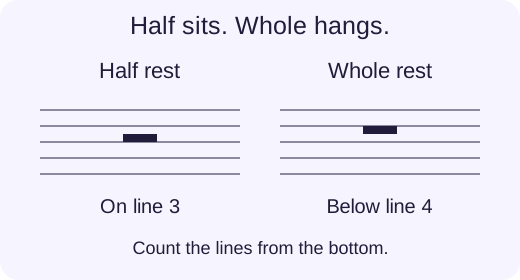
A half rest sits on a staff line. A whole rest hangs below one. In 4/4, count two beats for the half rest and four for a whole-bar rest. Keep the pulse moving while your hand is quiet.
Which rectangle is which?
In ordinary single-voice notation, the half rest sits on the middle line; the whole rest hangs from the line just above it. Count staff lines from the bottom. Try this memory aid: half sits; whole hangs. Open Music Theory illustrates these rest shapes and their relative lengths.
A rest belongs to its written part or voice. Your other hand can still have notes to play. This explanation of rest length shows how separate parts can overlap. For the exercises below, use one hand, one comfortable key and no sustain pedal.
Exercise 1: wait two beats, then play
Set a slow, steady pulse. Count 1, 2, 3, 4 aloud before you begin. In this 4/4 practice pattern, the half rest takes beats 1 and 2. Press your chosen key on 3, release it as you press again on 4, then release at the next 1.
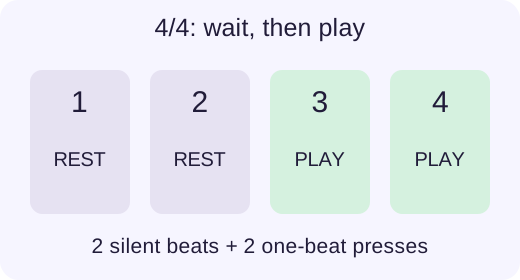
Repeat four times without adding a pause between repetitions. Check: each round has four beats but only two key presses. If you play on 2, say both silent counts aloud and try again. The aim is a steady entry on 3.
Exercise 2: a whole-bar rest in 3/4
A whole-rest symbol can stand for a complete silent bar. Read the time signature before you count it: in 3/4, that bar has three quarter-note beats. Do not add a fourth beat. Steps to Music Theory explains this whole-rest exception in section 3.4.
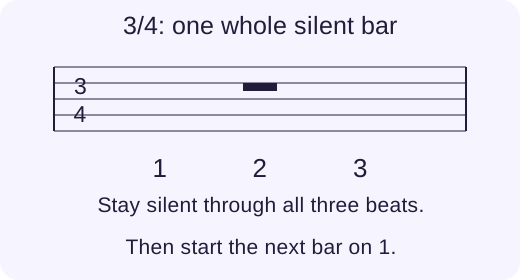
Count one silent bar, then play three even presses in the next: rest, rest, rest | play, play, play. Repeat. Check: two bars contain six beats and three presses. If your entry feels late, count in groups of three instead of four.
Keep the count going
Cover the labels in the first diagram and name each rest. Then repeat both exercises. For more practice, use our beginner rhythm exercises. To compare silence with holding a note, see ties and slurs on piano. You can also return to Ultimidi for your next piano practice session.